Your child may be having surgery to take out the tonsils or adenoids. If needed, the tonsils and adenoids can be taken out during the same surgery. The two procedures are described here.
Tonsillectomy
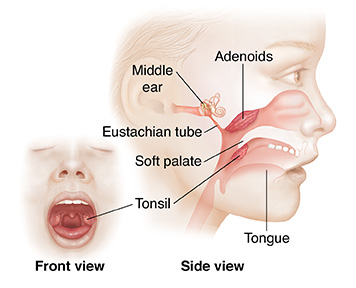
Tonsillectomy is surgery to take out the tonsils. The tonsils are two small masses of tissue that help the body fight disease. They are in the back of the throat, behind and above the tongue. The tonsils are easily seen. This surgery may be done if enlarged tonsils make it hard to breathe. It may also be done if the tonsils are often infected.
Adenoidectomy
Adenoidectomy is surgery to take out the adenoids. Adenoids refers to a single mass of tissue that helps the body fight disease. This mass is behind the nose and upper throat. It is near the passage to the middle ear (eustachian tube). It is hidden from view by the soft palate. This surgery may be needed if enlarged adenoid tissue makes it hard to breathe. It may also be done if infected adenoid tissue is causing ear infections.
Taking out the tonsils and adenoids is one of the most common surgeries in children. Their removal does not impair how the body fights infections.
Online Medical Reviewer: Melinda Murray Ratini DO
Online Medical Reviewer: Riley Holtz RN BS
Date Last Reviewed: 06/01/2025
© 2000-2026 The StayWell Company, LLC. All rights reserved. This information is not intended as a substitute for professional medical care. Always follow your healthcare professional's instructions.