-
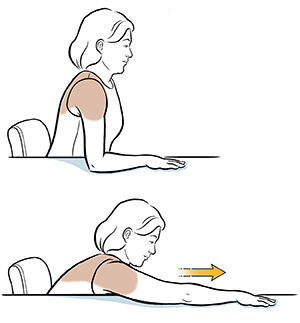
Sit in a chair sideways next to a table. Lay your right arm on the table, pointed forward.
-
Slowly lean forward. Slide your arm forward on the table. Feel the stretch in your right shoulder.
-
Hold for 5 seconds. Slowly sit back up.
-
Repeat 5 times.
-
Switch sides and repeat, if instructed.
-
Repeat this exercise 3 times a day, or as instructed.
Safety tips
-
Stop right away if you feel any pain. Slight discomfort is normal, but you shouldn’t feel sharp pain while you’re doing these exercises or stretches.
-
Remember to breathe. Breathing well may also help you do an exercise or stretch for longer.
-
Start slowly. If you’re new to working out or doing shoulder exercises, don’t try to do too much too soon. Start with just a few exercises and stretches at first, then add more as you build your strength.
-
Check with your health care provider or physical therapist. If you’ve had shoulder surgery, an injury, or a lot of shoulder pain, it’s important to check with your provider or physical therapist before doing shoulder mobility exercises and stretches.
Author: Wheeler, Brooke
Author: Yang, Sue
Online Medical Reviewer: Lalitha Kadali
Online Medical Reviewer: Stacey Wojcik MBA BSN RN
Online Medical Reviewer: Trina Bellendir PT
Date Last Reviewed: 01/01/2025
© 2000-2026 The StayWell Company, LLC. All rights reserved. This information is not intended as a substitute for professional medical care. Always follow your healthcare professional's instructions.