A bursa is a thin, slippery, sac-like film that contains a small amount of fluid. A bursa is found between bones and soft tissues in and around joints. It cushions and protects joint structures and stops them from rubbing against each other. If a bursa becomes inflamed and irritated, it's known as bursitis.
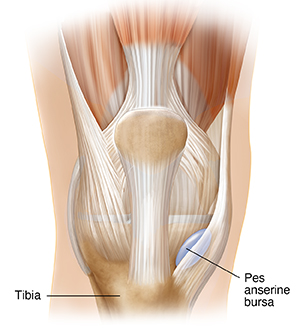
The pes anserine bursa is found on the inside of the knee joint. It lies between the shinbone (tibia) and three tendons that attach the hamstring muscles to the shinbone. Inflammation of this bursa is called pes anserine bursitis.
Causes of pes anserine bursitis
These may include:
-
Overuse of the knee during running or other sports.
-
Sports that need repeated side-to-side motions, such as in tennis or soccer.
-
Tight hamstrings.
-
Incorrect method. This includes not stretching before running, running uphill too much, or suddenly increasing miles run.
-
Being overweight.
-
Having knee arthritis.
-
Having MCL (medial collateral ligament) injury.
Symptoms of pes anserine bursitis
The knee joint may be painful. This pain may be worse with kneeling, going up or down stairs, or getting up from a chair. The pain often gets better with rest. The inner side of the joint may be swollen. It may also be tender and feel warm to the touch.
Treatment for pes anserine bursitis
Treatments may include:
-
Resting the knee . This reduces irritation and gives the bursa time to heal.
-
Sleeping with a cushion between the thighs . This limits pressure on the bursa.
-
Prescription or over-the-counter medicines . These help reduce inflammation, swelling, and pain. NSAIDs (nonsteroidal anti-inflammatory drugs) are the most common medicines used. Medicines may be prescribed or bought over the counter. They may be given as pills. Or they may be put on the skin as a gel, cream, or patch.
-
A weight-loss plan if you are overweight . This relieves pressure on the knee joint.
-
Stretching and strengthening exercises . These help improve the strength and flexibility of the muscles around the knee.
-
Cold therapy, such as using ice packs . This helps reduce swelling and pain.
-
Physical therapy . This may include exercises or ultrasound.
-
Injections of medicine into the bursa . These may help relieve symptoms. The medicine is usually a corticosteroid. This is a strong anti-inflammatory medicine.
For symptoms that don’t get better with these treatments, your doctor may recommend surgery to remove the bursa.
Possible complications
If you don’t give your knee time to heal, symptoms may return or get worse. Follow your doctor’s instructions on resting and treating your knee.
When to call your doctor
Contact your doctor if:
-
Symptoms don’t get better or they get worse.
-
New symptoms develop.
-
Fever, chills, or drainage occurs.
Author: Michels, Karen
Online Medical Reviewer: Raymond Turley Jr PA-C
Online Medical Reviewer: Stacey Wojcik MBA BSN RN
Online Medical Reviewer: Thomas N Joseph MD
Date Last Reviewed: 04/01/2025
© 2000-2026 The StayWell Company, LLC. All rights reserved. This information is not intended as a substitute for professional medical care. Always follow your healthcare professional's instructions.