Types

Pressure Injuries: Common Sites

Choose a preferred language

Bony prominences are the areas of bone that are close to the skin's surface. These areas are most susceptible to pressure injuries because they have the least amount of cushioning. They are also more vulnerable to friction and shear injuries. Which pressure points are vulnerable for a particular patient depends on the position in which most of that patient’s time is spent. Also check for pressure injuries on the skin over implanted medical devices, such as pacemakers.

Overall, the sacrum is the most common site for pressure injuries. Pressure injuries are also commonly seen on the:

  • Heels

  • Ischial tuberosity

  • Greater trochanter

  • Back of the head

  • Shoulders

  • Ears

  • Elbows

  • Inner knees

  • Malleoli (particularly the lateral malleolus)


Pressure points to remember
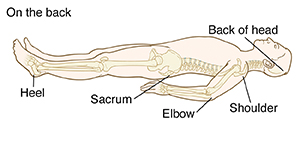
Outline of person lying on back with bones visible. Pressure points: Back of head, shoulder, elbow, sacrum, and heel.

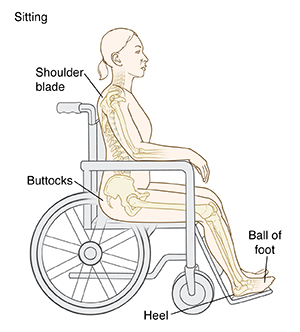
Outline of person sitting in wheelchair with bones visible. Pressure points: Shoulder blade, buttocks, ball of foot, heel.

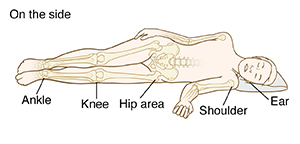
Outline of person lying on side with bones visible. Pressure points: Ear, shoulder, hip area, knees, ankle.

Online Medical Reviewer: Heather M Trevino BSN RNC

Online Medical Reviewer: Marianne Fraser MSN RN

Online Medical Reviewer: Shaziya Allarakha MD

Date Last Reviewed: 04/21/2014

© 2000-2026 The StayWell Company, LLC. All rights reserved. This information is not intended as a substitute for professional medical care. Always follow your healthcare professional's instructions.


Related Articles
Read article
Skin Health
Wound Check, Infection

A wound that has become infected will not heal properly unless the infection is cleared. Infection in a wound may also spread if it is not treated.

Read article
Skin Health
Plant and Sun Dermatitis (Phytophotodermatitis)

Plant and sun dermatitis (phytophotodermatitis) is an inflammatory reaction of the skin. It occurs after contact with the leaves and stems of certain plants, followed by sun exposure. It starts with a burning feeling followed by a red rash, and sometimes blisters. Learn how to care for yourself at home.

Read article
Skin Health
Tinea Versicolor

This is a rash caused by a fungus in the top layers of the skin. Health experts don't know why some people get this rash and others don't. Here's how to care for the rash at home.

Read article
Wellness
Eating a High-Protein Diet for Wound Care

If you have a hard-to-heal wound, your healthcare provider may advise you to eat more protein.