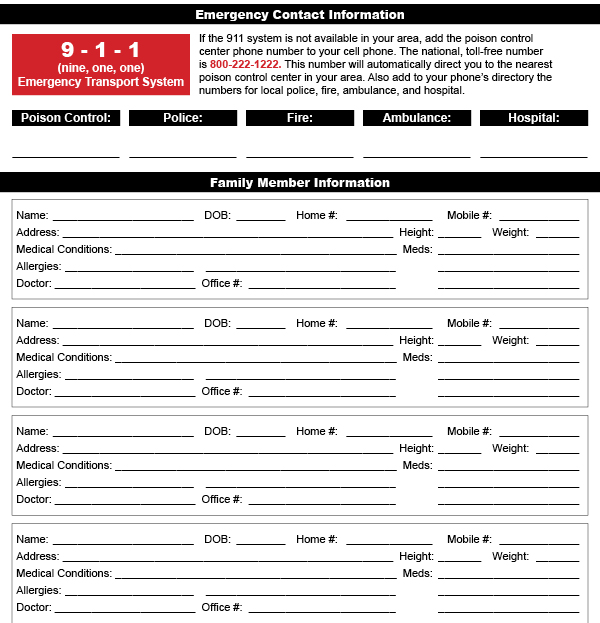
In an emergency, it's easy to forget even the most well-known information. That is why it's crucial for you to complete information, such as in the form below, for each member of your household. Make sure the contact sheet is kept in a place at your home where all members can access it. It's also important to keep a copy in your car, place of work, and with you at all times. Update the information often.
Make copies for nonresident relatives, babysitters, caretakers, neighbors, teachers—anyone who has contact with you or who may be responsible for your children (or any disabled or older adult people in your home).
In this age of technology, there are also choices available for your smartphone. Apps for listing ICE (In Case of Emergency) contacts are available. They can be downloaded for free or at a small cost, or they may be built into your phone. Search your app store for "ICE Emergency" apps, or check your phone settings for a built-in app. These are important tools that can increase the chance for survival in an emergency.
Older people or people with multiple health problems may need a more extensive card outlining all of their doctors and medicines.
Online Medical Reviewer: Eric Perez MD
Online Medical Reviewer: Ronald Karlin MD
Online Medical Reviewer: Tara Novick BSN MSN
Date Last Reviewed: 05/01/2025
© 2000-2026 The StayWell Company, LLC. All rights reserved. This information is not intended as a substitute for professional medical care. Always follow your healthcare professional's instructions.