Understanding Healthcare

Measuring Your Pain

Choose a preferred language

A pain scale helps you rate pain intensity. In the scale, 0 means no pain, and 10 is the worst pain possible. Pain scales aren't used to compare your pain with another person's pain. A pain scale is used only to measure how your pain changes for you. You should rate your pain every few hours. You may feel some pain even with medicines. It's important to tell your health care provider if medicines don't reduce the pain. Be sure to mention if the pain suddenly increases or changes.

Pain scale., from none, to mild, to moderate, to severe.

Keep track of your pain each day. You might copy the pain journal on this page or use a small notebook. Show the journal to your health care provider.
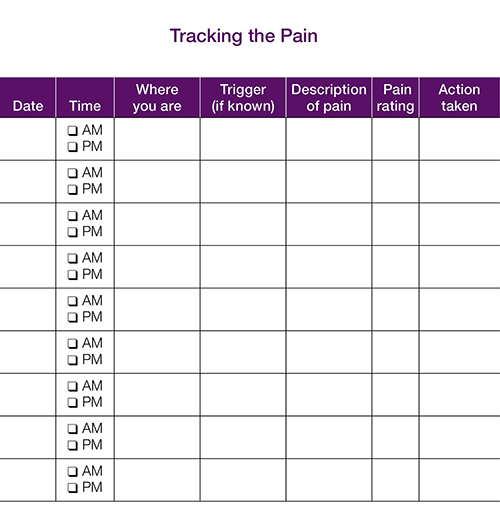
Pain chart to track pain, including date, time, where you are, trigger, pain description, pain rating, and action taken.

Online Medical Reviewer: Jimmy Moe MD

Online Medical Reviewer: Raymond Kent Turley BSN MSN RN

Online Medical Reviewer: Tennille Dozier RN BSN RDMS

Date Last Reviewed: 01/01/2025

© 2000-2026 The StayWell Company, LLC. All rights reserved. This information is not intended as a substitute for professional medical care. Always follow your healthcare professional's instructions.


Related Articles
Read article
Wellness
Sympathetic Nerve Block: Your Experience

During this test, your health care provider injects medicine near your spine to "block" the sympathetic nerves in that region. This injection is used to help diagnose and to treat certain nerve problems, including chronic pain.

Read article
Wellness
Discharge Instructions: Giving Yourself an Intramuscular (IM) Injection

You were shown how to give yourself an Intramuscular (IM) injection in the hospital. Use this sheet to help you remember those steps when you are at home.

Read article
Wellness
Understanding Thoracic Epidural Injection

A thoracic epidural injection is a shot that helps ease pain in your upper to middle back (thoracic) area. Medicine is injected into the area around your spinal cord.

Read article
Wellness
Acute Pain, Uncertain Cause

Pain can be caused by many conditions that range from very minor to very serious. In some cases, though, pain comes and goes with no apparent cause.
